Thought leadership

Beyond navigation: A better driver experience

Trimble’s Rishi Mehra examines how the latest Trimble CoPilot enhancements improve fleet routing, reduce friction and better support drivers.

Decoration image

Beyond navigation: Why the driver experience is the next competitive advantage

Keeping drivers productive and engaged has never been more important.

Carriers continue to navigate persistent driver shortages, rising operating costs and increasing customer expectations, all while asking drivers to safely move freight through more complex transportation networks. In today's environment, the technology drivers interact with every mile of every trip has become an essential part of the driver experience.

That's why fleet technology must continue to evolve.

With the upcoming release of Trimble CoPilot 11.4, Trimble is introducing enhancements that help fleets improve routing precision, reduce workflow friction and give drivers more practical support throughout the day. Rather than focusing on a single feature, the release reflects a broader commitment to making commercial navigation more intelligent, connected and driver-centric.
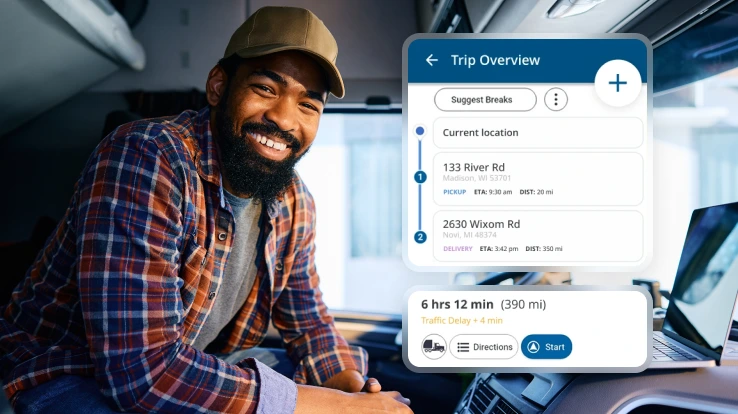
Supporting drivers beyond navigation

Drivers need more than turn-by-turn directions. Operating a commercial vehicle today is an incredibly complex, high-stress endeavor that goes far beyond driving from Point A to Point B. And amid a persistent industry shortage, keeping the drivers you have is more critical than ever. According to the Spring 2026 Truck Driver Survey, a record 58.1% of commercial drivers are actively looking for a new job—citing operational friction, poor communication and daily on-the-road frustrations as top reasons for wanting to leave.

The lesson is clear: to elevate fleet performance, carriers must first elevate the driver experience.

CoPilot 11.4 answers this call with the introduction of Driver Assistant, an AI-powered tool designed to support hands-free interaction, keeping your drivers’ attention on the road. Using natural language, drivers can ask questions, receive route information, access app functions and complete common tasks while keeping their focus on the road.

Routing that reflects real-world operations

Commercial fleets routinely face routing decisions that consumer navigation apps aren’t designed to handle. Apps designed for passenger vehicles ignore critical commercial factors like vehicle height, weight limits and hazardous material restrictions. Relying on consumer-grade GPS can have severe real-world consequences; for example, the US Federal Highway Administration reports that US bridges and tunnels are struck approximately 15,000 times every year—a safety crisis heavily fueled by trucks using consumer-grade mapping. With the average collision costing fleets potentially hundreds of thousands of dollars in damages and fines, using the wrong map is an expensive gamble.

CoPilot 11.4 addresses this by introducing enhancements for hazardous materials routing, vehicle length and trailer handling. By supporting multi-select HazMat placards, the routing logic now evaluates restrictions across multiple cargo classes simultaneously and aligns directly with the physical signs on the truck to eliminate translation errors and back-office ambiguity. It also introduces support for total length, max straight length, and specific trailer-related restrictions to better handle complex commercial vehicle configurations. These improvements help fleets generate routes that align closely with operational realities, supporting safer, more compliant decision-making while keeping drivers on legally approved paths.

CoPilot 11.4 helps fleets improve routing precision while creating a more connected driver experience.

CoPilot 11.4 helps fleets improve routing precision while creating a more connected driver experience.

Connecting the back office to the cab

A route is only valuable if everyone is working from the same information. With the average cost of operating a commercial truck sitting at $2.26 per mile and average truckload operating margins hovering in negative territory at -2.3%, there is zero room for operational error. When dispatch planning doesn't align with in-cab navigation, out-of-route mileage and billing discrepancies create an invisible cost leakage that directly eats into fleet survival.

New server-side route generation strengthens the connection between planning systems and in-cab navigation by allowing routes to be generated using current routing data before being delivered directly to the driver. The result is greater consistency between planned routes, contracted miles and the navigation experience in the cab, ensuring that the route you paid for is the exact route your driver takes.

Looking ahead

As transportation continues to evolve, the fleets that succeed will be those that invest not only in operational efficiency but also in the people behind the wheel.

The latest CoPilot enhancements are designed to help carriers improve routing precision, simplify driver workflows and create a more connected in-cab experience. Together, these capabilities represent another step toward helping fleets operate more efficiently while giving drivers the modern tools they need to succeed.

Whether managing a handful of trucks or thousands of vehicles, investing in a better driver experience ultimately helps create a stronger, safer and more resilient operation.

Share this post:

Ready to see how CoPilot can transform your fleet?

Learn more about CoPilot or contact our team to explore how intelligent commercial navigation can support your fleet.